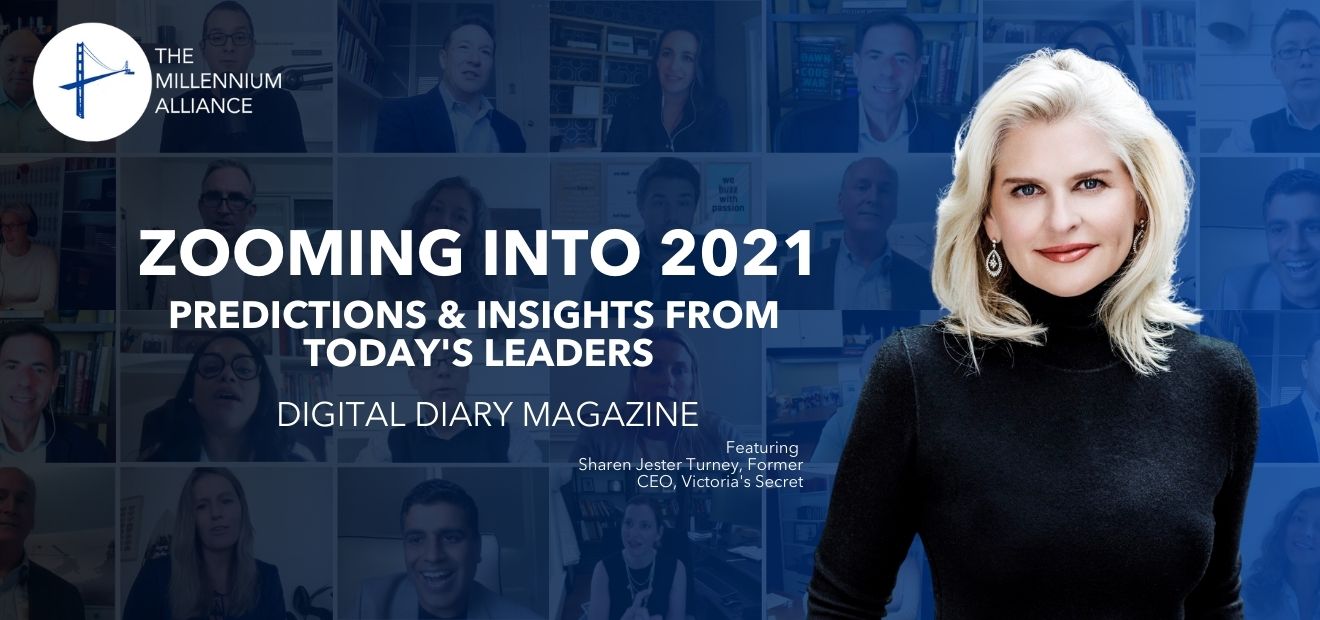
Going “Forward”​ to Work in 2021 with David Sable

As originally published by David Sable on Linkedin. Subscribe to the newsletter!

Going “Forward”​ to Work in 2021

Dear Reader,

I promise you this is not yet another 2020 look-back about the year we lost, about masks or just plain misery. And it’s not a prediction for 2021…my Cloudy Crystal Ball will wait until later on in January to reveal itself.

Clearly and appropriately, we need to pause and acknowledge the tragic loss of life—much of it sadly needless, as our lack of planning for disaster caught everyone flatfooted and caused weeks, if not months, of spinning and just plain catch-up. I’d also be remiss if I didn’t point out that this same lack of planning is causing the incredible FUBAR of vaccine distribution.

How could we move forward without understanding that way too many businesses closed, while others made unconscionable profits all while people remain out of work, many hungry and homeless? As 2021 progresses, we cannot let anyone fall by the wayside.

I’d further be remiss if I didn’t call out the relentless spread of fake news and conspiracy crap from the highest placed people in the world, which continues to be amplified by out-of-control social media, elevating levels of hate to their highest points.

And yet…there have been incredible acts of charity and kindness—pivots that have saved business and jobs. We’ve seen tremendous ingenuity demonstrated by parents and business alike. Friends and families have come together like never before. And a vaccine has been developed in record time, despite it all.

Advertising in 2020 has also stood the test. Despite the many predictions of doom, the ad industry pulled its own weight, and in many ways, has had its best year, revealing its importance in informing, educating and entertaining during the darkest days of the pandemic.

With that, I wish you all a happy and healthy 2021—a year of not going back to work but of going forward to work, of proud mask wearing, of appropriate muting …more than not, of pivots and ingenuity, and most importantly, of empathy. In 2021, let’s activate to help our friends, colleagues and children, and all others around the world who have struggled in 2020, and give them a chance for a better year in future.

Thank you all for inspiring me by reading “Imagine” and my rambles, and for challenging me with your thoughts, comments and questions.

#MillenniumLive with DarioHealth on Digital Healthcare & Chronic Disease Management

#MillenniumLive is pleased to have Omar Manejwala, M.D., Chief Medical Officer at DarioHealth, on this week’s podcast episode. Omar is a leading expert on behavioral health and chronic disease, and with DarioHealth, he works to offer personalized solutions to revolutionize the way people with diabetes and hypertension manage their chronic conditions. In this podcast episode, we discuss the state of chronic disease today, the impact it has on both providers & payers, and how telehealth is transforming care management across the healthcare ecosystem.

About DarioHealth

With tens of thousands of active users worldwide and proven clinical outcomes, DarioHealth is a global digital therapeutics solution leader. Dario is revolutionizing the way people with diabetes and hypertension manage their chronic conditions. Built for and around the user, Dario offers personalized solutions that combine best in class digital technologies, analytics, hardware, and coaching to encourage and inspire users to proactively manage their health every day.

Go here for more information

#MillenniumLive Keynote Series with David Edelman

On this episode of #MillenniumLive, David Edelman, Executive Advisor and former Chief Marketing Officer at Aetna, discusses all things patient experience at our recent Patient Experience & Digital Healthcare Transformation Assembly. He explains that as digital technology advances and the challenges of COVID-19 fade, patient experience will contribute even more to providers’ success. Improving overall experience is essential with the growing number of players in the market, and it requires finding new ways to connect to the patient, improving health outcomes and lowering cost.

Go here to listen to the podcast episode or watch the full video below.

About David Edelman

David Edelman is the Former CMO at Aetna and present-day consulting leader in Digital Transformation and Marketing Strategy. David Edelman has built a global reputation, grounded by his development of foundational marketing concepts such as “The Customer Decision Journey,” and “Segment-of-One Marketing.” He has been repeatedly recognized by Forbes as one of the “Most Influential CMOs in the World,” and by AdWeek as one of the “Top 20 Marketing and Technology Executives.” His writing and work has attracted over 1.2 million followers to his LinkedIn blog. For the last four years, David served as Chief Marketing Officer of Aetna, now part of the $200B healthcare giant CVS Health, and ran its “Digital First” enterprise modernization program. He drove a broad transformation at Aetna, rebranding the 166 year-old company, implementing real-time analytics, and building agile operations.

Solving for the Missing X: David Sable’s Equation for Success

As originally published by David Sable on Linkedin. Subscribe to the newsletter!

We live in a world where time is of the essence. As marketers, we know that the key to retaining customer loyalty is by making sure that consumers feel their time/attention/money is being spent in a worthwhile manner. I like to sum up this idea in the following way: “Don’t bother me unless you’re adding value to my life.” However, since it’s not always clear how best to achieve this, I’ve created a helpful equation to guide myself and my colleagues towards success. Check it out in today’s video edition of Imagine.

#MillenniumLive with Clearwave Scheduling

#MillenniumLive is joined by Cliff Browning, VP Sales at Clearwave Scheduling (formerly Odoro), a leading solution for online patient scheduling. Browning shares with us what health systems need to take into account when they make a decision on a scheduling solution, what makes their solution more flexible than others on the market, and how call centers can benefit from the platform.

Go here to listen to the podcast episode!

About Clearwave Scheduling

Empower patients and practices to self-schedule with a smart scheduling platform complete with automated eligibility that reflects organizational preferences and priorities and that practices can control in the moment and in the future.

With a 24/7 online scheduling solution that can be embedded into an existing website or mobile app, your practice becomes instantly searchable, allowing new patients to shop for care and schedule appointments with providers. Working seamlessly across desktop and mobile devices, smart scheduling is accessible for all patients, ensuring accurate, real-time patient-provider match incorporating patient, provider and health system needs.

Go here for more information

What’s New in Healthcare with Janell Pittman, CMO & CDO of MercyOne

The healthcare landscape is constantly evolving over the course of the pandemic, and healthcare providers are tasked with making life-saving innovations faster than ever before. We reached out to our member and recent panelist Janell Pittman, who is the CMO & CDO of MercyOne hospital network. She sheds light on what’s new in healthcare, how she’s planning for the long winter and fills us in on how COVID-19 changed her organization.

If you’re interested in joining the discussion at our next healthcare assembly, go here to RSVP for our Healthcare Payers & Providers Assembly on April 20-21, 2021!

Q: Has your organization made the transition to telehealth? If so, was the platform in place prior to the pandemic, or developed as a result?

JP: Yes. One platform was in place prior and we added another as a result. We went from 200 telehealth visits a week to 8,000 telehealth visits a week at our max (so far).

Q: How important is face-to-face patient care to your current practice?

JP: Very important. We believe long term our differentiator will be combining various access points into a seamless experience.

Q: We’ve seen the healthcare space dramatically evolve over the course of the pandemic. How are you preparing for what’s expected to be a long winter?

JP: We have the foundations set for the winter with the largest challenge requiring ongoing action being staffing. We are focused on preparing for para-COVID and post COVID success.

Q: With an influx of data on both the provider and payer sides, what’s your strategy for determining what data is useful and how it can improve patient experience?
JP: We are working to scale a solution aggregating inputs.

Q: What makes experience design so critical for healthcare companies, and how do you define a “better experience”?
JP: Radical convenience and personalization. Culture is critical!

Q: How has your organization changed since the start of the pandemic?
JP: More agile, more focused on support of our colleagues and better able to prioritize.

Q: How has continued education affected your professional growth?
JP: Keeping me continuously aware of ways to be a better leader and marketer so I can impact MercyOne’s Mission.

Q: What value have you gained from working with The Millennium Alliance?
JP: I’ve made connections to peers from across the country!

#MillenniumLive Keynote Series with Craig Richardville

Craig Richardville, Chief Information and Digital Officer at SCL Health and Millennium Alliance Advisory Board Member, joined us earlier this month as the Keynote Speaker for our Healthcare Providers and Payers Transformation Virtual Assembly. In this episode of #MillenniumLive, he discusses the role of the CIO in healthcare, leveraging digital assets to make healthcare more personalized, and the under-utilization of patients as a resource in optimizing care. He defines digital health as the convergence of digital assets within healthcare in order to enhance access, provide efficiency and self-service capabilities, and make healthcare more personalized and precise. He also discusses how the four different stakeholders- associates, consumers, providers, and patients- can utilize these assets for mutual benefit.


Go here to listen to the podcast episode or watch the full video below.

About Craig Richardville

Craig Richardville is the SVP, CIO & Digital Officer at SCL Health. His responsibilities include leading all aspects of the health system’s information technology strategy and operations, including enterprise systems and applications, information security, core infrastructure and leading the system’s digital transformation and information automation. Previously, he served as owner and president of Richardville Consulting LLC, delivering resource, advisory and brokerage services for innovative start-up software and services companies. Prior to that, he served as Senior Vice President & Chief Information and Analytics Officer at Carolinas HealthCare System (Atrium Health) for more than 20 years where he transformed the company into a national leader in the effective use of technology, utilizing data as a driver; analytics and business intelligence; artificial intelligence, machine learning and robotic process automation. His notable accomplishments include receiving the 2015 John E. Gall, Jr. CIO of the Year award from the College of Healthcare Information Management Executives (CHIME) and HIMSS in recognition of his leadership in driving digital transformation in healthcare and the 2017 CIO of the Year award for “Leadership” presented by Charlotte CIO for his impact on the technology industry across all verticals. Craig earned his master’s degree in business administration and also his bachelor’s degree in business administration from University of Toledo.

#MillenniumLive on the Shifting Retail Landscape with Venky Shankar

This week’s #MillenniumLive features Venky Shankar, Coleman Chair Professor & Director of Research at Texas A&M. Recognized as one among the World’s Most Influential Scientific Minds by Thomson Reuters and as a Top 10 scholar worldwide on innovation, Venky Shankar is a true expert in marketing strategy, artificial intelligence, digital business, and more. He joins us for a conversation on the continued shift to E-Commerce, Artificial Intelligence, and digital transformation in retail and marketing.

Go here to listen to the podcast episode or watch the full video below.

About Venky Shankar

Venkatesh (Venky) Shankar is Coleman Chair Professor of Marketing and Director of Research, Center for Retailing Studies, Mays Business School, Texas A&M University. His expertise includes artificial intelligence, digital business, marketing strategy, innovation, retailing, international marketing, and pricing. He has been recognized as a World’s Most Influential Scientific Mind and as Top 10 scholar on innovation. He is winner of AMS Cutco/Vector Outstanding Marketing Educator Award for lifetime contributions to marketing, Lifetime Achievement Award in Retailing, Mahajan Award for Lifetime Contributions to Marketing Strategy, Distinguished Alumnus Awards from IIM and IIT, Clarke Award for the Outstanding Direct and Interactive Marketing Educator, and Long-term Impact, Green and Lehmann Awards for research. He is Co-Editor of Handbook of Marketing Strategy and author of Shopper Marketing. The Shankar-Spiegel Award is named in his honor. He is ex-President of Marketing Strategy SIG, AMA and serves on CMO council and B2B Leadership Board. He was an Academic Trustee of MSI. He is Editor-Emeritus of Journal of Interactive Marketing and serves on the policy boards of JR and JIM. He is a three-time winner of Krowe Award for outstanding teaching. He has been a visiting faculty at Stanford University, MIT, INSEAD, Singapore Management University, SDA Bocconi, Chinese European International Business School, and Indian School of Business. Venky has a Ph.D. in marketing from Kellogg School, Northwestern University. He has consulted or had executive development experience with companies like Coca-Cola, Colgate Palmolive, Deloitte, Glaxo SmithKline, Hewlett Packard, HSBC, IBM, Intel, Marriott, Medtronic, Microsoft, PepsiCo, Philips, and Volvo.

Individual Recognition and Accountability Leads to an Early Indicator of HCAHPS

Healthcare organizations work tirelessly to impact and improve patient experience, constantly reviewing feedback, and analyzing data to drive meaningful change. While much can be affected through traditional standardized data, there is a struggle to understand accountability and impact on an individual and real-time level. Research shows a patient may interact with 50 nurses, physicians, and support staff across multiple disciplines, making it difficult to identify areas of improvement when faced with generalized, delayed feedback. This case study examines how the real-time, individualized data in Wambi, the first and only real-time engagement and recognition system that includes all key stakeholders in healthcare including patients, clinicians, healthcare staff, and leaders, creates transparency into these individual experiences and has been shown to be an early indicator of the HCAHPS (Hospital Consumer Assessment of Healthcare Providers and Systems) results in key communication domains, and in fact that Wambi’s patient review questions directly correlated with a hospital’s 5-10% improvement.

Read the case study from our partners at Wambi here

When Failure Creates Leadership: David Sable’s Take on Moving Forward from Failure

As originally published by David Sable on Linkedin. Subscribe to the newsletter!

What does failure have to do with leadership?

“Obvious!” some might say, “If you fail you are a loser!”

I’ll ask again: What does failure have to do with leadership? EVERYTHING. Because great leaders know how to fail and move on to greatness. It’s the losers who don’t.

Clearly failure and losing are on many people’s minds these days as the world stage reverberates with real time (if not reality) drama. And, as leadership is a topic near and dear to me, I was inspired to share some thoughts on the subject today. So, here is the next installment in my ongoing series on leadership:

Some of the most iconic leaders, before reaching the peak of their potential, were rejected, thrown out, ignored, told they were useless, not creative, boring and to “get another job.” The best remained undeterred. They didn’t whine, blame others, slink away or otherwise leave the playing field angry, bitter or negative. Instead, each continued to move forward, persisted in breaking new ground. And the rest, they say, is LEADERSHIP.

Here are a few examples of some of those kinds of leaders, all of whom continue to inspire:

Walt Disney: Mickey Mouse is a household name in as many countries as there are people, and possibly one of the most recognizable icons ever created. Yet ole Mickey almost never was. When Walt Disney first took his idea of Mickey Mouse to MGM, he was told that the idea would never work because a giant mouse on a screen would terrify women. Add that to the newspaper editor who fired him because he believed Walt, “lacked imagination and had no good ideas,” and we have a man who transcended criticism and rejection to become an iconic leader in entertainment—not to mention an innovator and entrepreneur. Failure? Leadership!

Robert Goddard: The vaunted New York Times once wrote an editorial about the father of modern rocketry. A brilliant innovator with over 200 patents to his name, about Goddard the NYT wrote, “[He] does not know the relation of action to reaction…he only seems to lack the knowledge ladled out daily in high schools.” And, as if the ridicule that came from all sides wasn’t enough, he failed time and time again. Yet he never saw failure, only what he called “valuable negative information.” 49 years later, three days before the first moon landing, The New York Times redacted the editorial. Goddard made Elon Musk possible. Goddard embraced Failure…Leadership!

Charlie Chaplin: Poverty. Neglect. Little formal education. A Dickensian childhood. No early screen credits. Chaplin found fame in the little tramp and in his own brilliance as creator and director. He created history in cinema and is today, a king of comedy. Said Chaplin, “Failure is unimportant. It takes courage to make a fool of yourself.” Let me paraphrase: Failure is unimportant if you are a true leader.

Steve Jobs: We remember him as a visionary who changed the world, or at least the world of computers and phones and digital services. That’s enough, no? Yet it’s vital to remember that Steve failed many times and with products, service and ideas. He was even fired by the company he created, built and led. Jobs didn’t slink, away drowning in self-pity, though. His motto? “You have to be willing to fail…you got to be willing to crash and burn.” He came back having learned from the crash and burn, stronger than ever…a leader for the ages.

Charles Darwin: Talk about success…Charles Darwin’s name has become ubiquitous, around the world, when describing any kind of evolutionary process. It can be social, societal, sports related—just about anything in fact. His observations were brilliant and created new areas of thinking, exploration and investigation. And, you guessed it, as a child he was considered average at best. He hailed from a wealthy, accomplished family—his father, a doctor. Darwin hoped to follow in his footsteps but was thrown out of medical school, so instead, he studied for the ministry. That is until he followed a friend around the world and took the groundbreaking path we know him for today. About himself, he wrote, “I was considered a very ordinary boy, rather below the common standard of intellect.” Yet, his thinking has been called “the most powerful and most comprehensive idea that has ever arisen on earth.” Another “failure,” who will be remembered as a great leader forever.

And one more:

The Beatles: About them, their first record company, Decca Records, wrote: “We don’t like their sound, and guitar music is on the way out. They have no future in show business.” From obscurity, through all the setbacks, failures and fights, they worked hard and are arguably the most famous and successful band of their genre…ever. To quote John Lennon, “Everything will be OK in the end, if it’s not Ok it’s not the end.” Leadership will not stop until it’s all OK, and even then, it will continue.

And there you have it. The indomitable spirit that’s actually fueled and energized by failure, the positivity that’s created by failure, the never-to-be-forgotten leaders who were forged by failure.

COVID-19, U.S. elections, the economy, climate, hatred, racism, anti-Semitism, Islamophobia, self-serving partisan politicians, crime, violence…add your own issues. It’s so easy to look around and feel that we have failed as society, as individuals as countries, cultures and religions. But let us learn from the leaders who viewed failure as a lesson—not a punishment or destiny. Failure can be seen as a proud symbol of leadership if, and only if, you can learn from it, leveraging the experience to ultimately move on and to change the world.

Said Thomas Edison, another great leader who failed many times and who will long be remembered and celebrated:

“I have not failed. I’ve just found 10,00 ways that won’t work”

Unless we embrace this philosophy, we will mire ourselves in negativity, and failure will be the norm, with leadership being a thing of the past.

What do you think? Please share your own examples!