EXECUTIVE SUMMARY
In the past few years Burger King built a reputation for itself. The brand mastered the art of using creativity to get people’s attention and build brand love. McWhopper, Google Home of the Whopper, Burning Stores, among many others got talked about everywhere, achieved billions of impressions, helped revamp the brand and got celebrated by our industry. Surely many of our blockbuster campaigns drove traffic (bringing people to restaurants) and sales. But the main focus of most of them was to “make the brand cool again”. That’s why we see Whopper Detour as a defining moment for our brand. There is a clear before and an after Whopper Detour. This campaign marks a turning point in our marketing and shows what we believe the future of great creativity might be (at least for us). A future where creativity is only used to (and celebrated for) responding to real, tangible business and brand goals.
This is an idea which plays with technology which is not necessarily new. Geofencing and mobile order and payment have been around for a while. It’s also not easy to convince people to download mobile apps from fast-food brands (especially burger chains). Many brands (including ourselves) couldn’t get people to download their apps even when giving products away. Yet, Whopper Detour increased the BK mobile app sales by 3x during the 9-day promotion and by 2x ever since the promotion ended. This campaign catapulted BK’s app from a modest #686 in the app store to #1 (across all categories; on both iOS and Android). It also drove the highest foot traffic (people coming to the restaurant) in 4.5 years.
So, the question is: How the hell did that happen?
This is the story of a crazy idea that delivered real business results. Scratch that — insane business results. An idea that bent the rules of direct marketing, experiential and e-commerce/technology. An idea with scale and long-term impact.
This case not only shows the power of a big idea and what it takes to make something different happen, but also the reason why our creative partners (aka advertising agencies) are so relevant. Big creative ideas eat programmatic, AI, trends, and even a beautifully put together McKinsey presentation for lunch. And these days people seem to forget that a bit. Big ideas is where our industry should focus. We used the art of creativity to get people’s attention, build brand love and build our business today and tomorrow. In scale. This was not a one location, one day stunt that gets people to talk about it (especially industry people) but is not linked to results. When we celebrate ideas like this one, we show that our industry (advertising and creativity) can indeed have a bright future and will be able to continue to have fun and make great business. And that’s the main reason we wrote this case study and are sharing it.
If you don’t have time to read (which would be a shame!), watch this:
Whopper Detour is one of my favorite Burger King ideas ever. It took us about a year to make. The idea came to us from FCB New York, and evolved a lot over time (a characteristic we see in all of our best campaigns). It involved a large team to pull it off, including our technology team and key tech partners. We basically had to recode our newly updated mobile app with mobile order and payment to now also work well and consistently with geofencing. In fact, to make this idea work we had to geofence all of our restaurants in the United States (more than 7,000) and all of the McDonald’s restaurants (more than 14,000). Plus, make it reliable! Can you imagine the amount of time and pressure to make this happen? But it paid off. Big-time.
We are investing a lot to improve our guest services at Burger King and technology has a key role in this. After all, mobile has grown to be a vital player in the QSR space, poised to be a $38 billion industry by next year (Source: QSR Magazine, Sep 2017). But, mobile order and payment isn’t new to people, nor is geofencing. So, to get people to actually care about our BK app is a testament to the beauty of this campaign, which started with a very simple PR headline: “You will be able to order a Whopper for 1 penny at McDonald’s.” Wait, what? That’s kind of a mindf**k. A Whopper at McDonald’s? That’s the exact opposite of what most direct marketing campaigns aim to achieve (you are asking people to go to your competitor before coming to you!). That’s turning brand experience upside down. And that’s showing how technology plus creativity can open new doors for brands and businesses. And while it is admittedly a bit crazy, that tends to be an ingredient in all our best ideas.
The objective of this article is to share a bit of our journey making Whopper Detour happen. By doing so, we aim to showcase the power of teamwork and creativity to drive brand and business results.
THE EXTRA MILE
It was beginning of September, back in 2017. FCB NY and Waze (their partner) reached out to us to share an idea. The starting point/insight revolved around the fact that Burger King has significantly fewer restaurant locations than McDonald’s. And since, in the U.S., most of the revenue comes from drive-thru, it’s fair to say that, quite often, BK fans have to drive longer distances to get their flame-grilled Whopper sandwiches. So, the idea was to reward these folks who are going “the extra mile” to enjoy Burger King, literally earning a discount for passing McDonald’s on their way.
No alt text provided for this image
Image 1. A simple demonstration of how the idea could work.
The presentation was pretty complete, with an overview on how to expand on the idea at different touch points, ranging from social media to out-of-home. The idea was presented as an idea that would trigger headlines and conversations, both highly desirable outcomes in all of our successful Burger King campaigns.
No alt text provided for this image
Image 2. Examples of social media amplification, out-of-home and potential headlines.
At the time, we thought there was something really interesting around the idea. We never played with geo-location before and a partnership with Waze sounded like a cool thing to do. Also, despite the fact that drive-thru is indeed our most important channel, we haven’t really done any drive-thru ideas in the recent past.
With that said, when comparing the “voltage” of the idea with other ideas in our pipeline, we felt that there were other things that had the potential to drive stronger talkability and PR. So, we decided to provide feedback, which was pretty much like: “There is something here that we like. Let’s keep working on it.”
“LET’S KEEP WORKING ON IT”
I think that if I were a creative working at an agency, “let’s keep working on it” would be one of the phrases that would scare me the most. What does that mean? Does the client really like it? Or are they just killing us softly? I think that “let’s keep working on it” probably means the end. Well, not in this case.
One thing we’ve learned in the work we do at Burger King is that many times we hit the right territory, but the idea is not quite right yet. In fact, I can think of many territories that took us more than a year to connect to the right idea. And in some cases, even more than that (or never at all). We don’t have an issue shooting an idea dead if we don’t think it has legs. So, when we say “let’s keep working on it,” we mean it. But neither FCB NY nor Waze had worked with us before. And I am sure that there was uncertainty about a potential positive outcome coming out of this.
Believe it or not, FCB NY continued to work on it. The talented team lead by Ari Halper and Gabriel Schimitt kept thinking, playing and polishing the idea. I guess they believed in it so much that they glanced over the uncertainty and kept pushing. So, around mid-November (2-3 months after the first presentation), we got an email from Gabriel saying that “they changed something on the idea and now it was waaaaaaaay better” (that’s how Gabriel speaks when he believes in something). I had a meeting in NY during that week, so I decided to stop by at FCB NY and take a look at that “waaaaaaaay better” version of the idea.
So, the new version of the idea was called “The Secret Whopper.” The insight of the idea was pretty much the same. The first page of the presentation said:
“Burger King has significantly fewer stores than McDonald’s, so we’re not always the closest option. How do we turn fewer stores into an opportunity and reward drivers willing to go the extra mile for a better burger? By turning our competitor’s stores into ours.”
That was the genesis of “The Secret Whopper: A special Whopper available only at McDonald’s.” Wait. What? Yes, that’s what they proposed. And we loved it.
FCB NY also suggested a simple flow for the idea using our BK Mobile App.
No alt text provided for this image
Image 3. BK mobile app flow for “The Secret Whopper” idea.
The agency also presented a series of additional assets to help bring the idea to life.
No alt text provided for this image
Image 4. Example of a potential billboard execution for “The Secret Whopper” idea.
The idea clearly evolved a lot. And the agency managed to tap into something that was very important for the brand: The mobile app. Remember that originally this was an idea that would happen mostly on the Waze platform.
At Burger King, we are investing a lot behind technology to improve guest services. And the mobile app is a key pillar in our strategy. If you think about fast-food restaurants, most of them have tended to leverage the same technology, and layout, for decades. The drive-thru, for instance, is kind of the same as it has always been (always a bit of a struggle to get that order taken the right way). For years the category failed to evolve much with technology (especially the burger chains). But recently, we have seen an acceleration behind initiatives around self-ordering kiosks, mobile apps, etc. The importance of technology among all fast-food players increased in the recent past and that’s no different at BK.
Back in November 2017, our Burger King app was basically a coupon app. Oh, we also had a store locator (d’oh!). But we had ambitious plans. We were working to develop mobile order and payment. That was a big deal for Burger King. It is really hard to code everything and make sure the app is integrated with our different point-of-sales systems (believe me, that’s a nightmare!). We wanted the app to work with geo-location, which would allow for small variations in price and menu for different restaurants, among others. A really big deal for Burger King. Yes. For Burger King. ’Cause mobile order and payment is obviously not new. Even the guy who sells coffee next to my building in Miami has it. Kind of everyone had it. So, this was a big deal for us. Not such a big deal for the industry. That’s why the challenge was to come up with a big, creative idea to make people care/share and get earned media at the relaunch.
So, here was FCB NY, bringing an amazing idea to relaunch our mobile order and payment capabilities. We had only one piece of feedback: We didn’t think it should be a “Secret Whopper.” Instead, we recommended it be the regular Whopper. Why? Because our regular Whopper is our most iconic product and to sell that at McDonald’s would be the biggest WTF moment. No need for a special build.
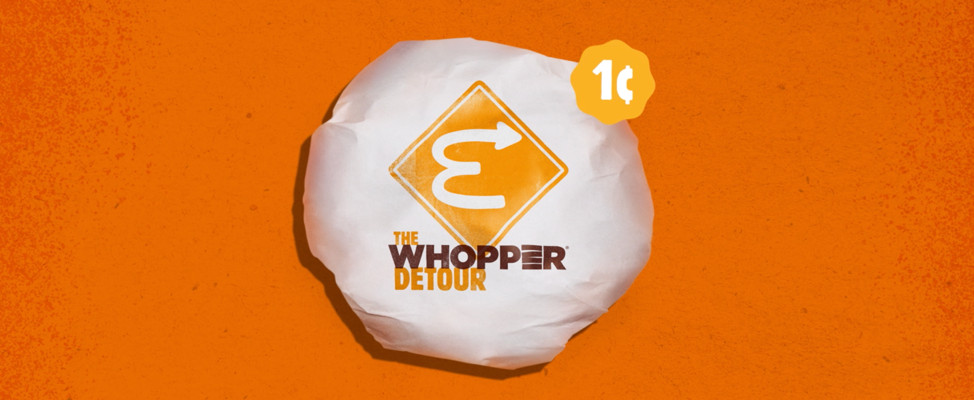
We also thought that the headline “You will be able to order a Whopper for 1 penny at McDonald’s” would be a bigger mindf*ck and, thus, potentially get more earned media and talkability than if we were saying “Secret Whopper.” And that’s when the name of the idea changed to become “Whopper Detour.”
MAKING IT HAPPEN
I still remember when FCB NY sent us a “happy birthday, Whopper Detour” via email in September 2018. Yes, it took us a year to develop the idea. As I mentioned earlier, we had to recode our mobile app with order/payment, plus geofencing on a massive scale, and then ensure it all worked flawlessly in just one year. Most people would have given up. We didn’t. We kept saying to ourselves: “If it were easy, someone else would have done it already. It’s a good thing this is freaking hard.”
Close to launch, the team developed a really cool film where our actors went to real McDonald’s restaurants in NY and tried explain to McDonald’s crew members at the drive-thru that they were there to get a Whopper for 1 cent.
No alt text provided for this image
Image 5. Image presented as part of Jonathan Klein’s visual treatment.
The film was shot by the very talented Jonathan Klein. We fell in love with his treatment. He simply got the tone of the brand and understood all the nuances.
“It’s important to stress that we are not making fun of the McDonald’s employees at all. Our actors asking about their Whopper orders from the BK App are delusional. Delusional people are funny. Delusional people ordering a Whopper at McDonald’s, compounded by the confusion of the McDonald’s employees, are hysterical.”
Our legal team was an intrinsic part of the development of this idea. In fact, that’s always the case. And we found a way to film this without necessarily asking for permission from our main competitor. The film had to be developed in NY for legal reasons; we would need to blur the faces of McDonald’s crew members and alter their voices a bit so they were not recognizable. On top of using the hidden cameras in the cars, we also filmed wide shots with lenses that allowed us to capture footage from a distance. As in any production that tries to capture reality, it started out messy and then got better and better. That’s normal. And we were patient. In the end, we ended up with an amazing (and very funny) film.
No alt text provided for this image
Image 6. Our brave crew shooting in NY.
On top of the film we created for PR and social media purposes, we ran a series of mobile out-of-home units with the objective of providing photo opportunities for bystanders. The UGC pictures quickly spread online.
No alt text provided for this image
Image 7. Our mobile out-of-home units driving around the U.S.
Another one of our favorite pieces was the print execution “Billions Swerved.” We all found it too funny not to deploy it. So… we had to make it happen. This is the type of execution that, despite leveraging traditional media, ends up getting a boatload of traction in social.
No alt text provided for this image
Image 8. The print ad we ran to help trigger earned media and talkability.
On top of FCB NY (who helped us with the campaign and UX), we had a pretty complete tech stack to launch Whopper Detour:
Tillster: Worked with our tech team coding the BK app (incl. mobile order and payment).
mParticle: CDP used to orchestrate data between the BK app and other CRM partners.
Radar: Geofencing used for unlocking, allowing us to tag all McD’s in the USA.
Braze: CRM vendor used to send push, e-mail and in-app messages.
Branch: Linking platform used to make it easier to get to BK App.
Amplitude: Analytics tool used to calculate redemptions, measure behavior and target mgs.
THE RESULTS
The world ended up talking about this campaign. We reached 3.5 billion impressions (billion with a “B”) with an equivalent USD $40 million in earned media (Source: Cision and ABMC). All without a significant media investment. We only did some guerrilla marketing (out-of-home), a handful of print ads and invested a tiny bit in digital (to push the film). We didn’t have TV, radio, social media influencers or others. The investment was really minimal because we knew the idea would take off by itself.
Case in point: To kick things off, FCB wrote a single tweet, “brb going to McDonald’s” — which came out about an hour before the campaign went live. That tweet alone racked up 65k likes in a matter of hours and led to an 818% increase in Twitter mentions.
We got more than 1.5 million people to download the BK App in the U.S. during the promotion (a 37.5% increase in only nine days), and more than a half-million redemptions of our promo (more than 40x redemptions versus our previous historical record for a digital coupon promo). And it continues to be the gift that keeps on giving, because in the months that followed the promotion, we are now up by 4.5 million downloads. All figures are sourced from Internal BK Data.
This direct, e-commerce, PR, integrated campaign propelled our BK App to become the #1 app in the Apple Store and Google Play Store (starting from #686 in the Apple Store and #464 on Google Play – Source: App Annie; beating out the likes of Facebook, Twitter, Instagram and YouTube). The BK App remained #1 in Food & Drink (our category) for more than 10 days on both platforms.
This idea was indeed a game changer for Burger King. Despite the fact that the Whopper sandwiches were going for only 1 penny, the total sales value sold through the mobile app increased by 3x during the promotion. And even after the promotion, we continued to sell through our mobile app 2x what we used to sell before the promotion. Whopper Detour users alone will spend around $15 million more per year on the BK mobile app. Yes, Whopper Detour put our mobile app on the map, made people engage with it, and now they continue to use it. Source: BK Internal Data.
Some skeptical people tend to challenge some of these sales results, arguing that we were selling Whopper sandwiches for a penny. But I am not talking about units sold. I am talking about total sales value. Even though we sold some Whopper sandwiches for 1 cent, the engagement was so high that people ended up buying a lot more. That’s why the business results were so strong.
The reality is that we tried giving away products to people who used our mobile app before. So have Wendy’s, McDonald’s, Chick-fil-A and others. That’s the obvious thing to do when you want people to download your app. But have you ever heard about any of those promotions? No, right? You know why? ’Cause no one cares. To make people care you need a BIG IDEA. An idea that plays with people’s imagination, an idea that is fun and connects people to the brand. Nothing was as powerful as Whopper Detour. And that is the true value of a creative idea.
No alt text provided for this image
Image 9. Download the app and get free food (Wendy’s, McD, Chick-fil-A).
Think about that. We asked people to download the BK app, add their credit card info, enable geo-location, drive to a McDonald’s, order from there and drive back to a Burger King to pick up the order. And they did it. It’s the opposite of what any direct marketing campaign has ever done. It’s experiential upside down. It’s a promo that, in theory, has all the ingredients not to work. But it did.
Perhaps most important, this activation drove people to our restaurants. By inviting people to drive to our main competitor to get a crazy discount, we triggered the highest weekly traffic increase (traffic = number of people coming to our restaurants) since mid-2015 (Source: Internal BK Data). Can you believe that? We asked people to go to McDonald’s and we triggered the highest increase in visits to BK in the past 4.5 years (!!!). And there was no cannibalization of the Whopper in the restaurant, which shows that the people who came were actually new or lapsed customers. And they ended up buying more than just the Whopper for 1 penny.
The ROI for the campaign was 37:1. And we had people seeing Burger King as a modern, savvy, interesting and fun brand.
5 LEARNINGS FROM OUR JOURNEY
Let the idea grow: Whopper Detour was not born as Whopper Detour. Not even the name. The idea was different. But the DNA of Whopper Detour was there. Somewhere. The ability to spot that and nurture the idea was critical for this case. Actually, in most successful cases we’ve developed, that seems to happen. “When a lion is born, it’s very easy to kill it” — Kash Sree used to always say that to me. You need to trust uncertainty and invest in the idea to make it better and better. It takes time. It takes effort. And it takes guts.
Big ideas matter: AI, AR, programmatic, machine learning, etc are all empty buzzwords if you don’t have a big idea. A big idea will eat big budgets, celebrity endorsements and, sometimes, even logic for breakfast. Without big ideas, our industry is boring. Actually, without big ideas, life is kind of boring. So, learn how to spot them and invest to make them happen. Don’t compromise.
The power of fun: This is an idea that had all the ingredients not to work. We asked a lot from the user. Credit card, location, space in their phones, a drive. And we gave a Whopper in return (not even, since they paid 1 cent). But people loved it. And 1.5 million people went for it. Why? Why the hell did that happen? Well, ’cause it was fun. It was fun to do it. It was fun to share it. It was fun to talk about it. Never underestimate the power of fun. It can bend logic.
If it were easy, someone else would have done it: Yes, we had to geofence more than 20,000 restaurants (all BKs plus McD’s in the U.S.). Yes, the app had to work flawlessly (or as close to that as possible). It was a technical nightmare to make everything happen. But we never thought about giving up. It took a year to make this happen. No shortcuts. If it were easy, someone else would have done it already. So BIG THANK-YOU to FCB NY, who believed in us as a client. Big thank-you to our tech team, who worked incredibly hard to make this happen. And big thank-you to all of our other agency partners (especially the tech ones) who helped us make this huge.
Remember the long-term benefits of an idea: We now have the location and credit card info of most of our app users. We can do a much better job in terms of CRM. We can do things such as send push notifications when a BK app user is getting close to a McD’s (’cause we did all the heavy lifting as part of Whopper Detour). In fact, our assumption is that the 1.5M downloads of Whopper Detour alone will trigger around USD $15M in revenue during the first 12 months of the project. So, despite the fact that the promo lasted for just nine days, the long-term impact of the project is truly significant.
Whopper Detour is one of my favorite Burger King ideas ever. It took us about a year to make. The idea came to us from FCB New York, and evolved a lot over time (a characteristic we see in all of our best campaigns). It involved a large team to pull it off, including our technology team and key tech partners. We basically had to recode our newly updated mobile app with mobile order and payment to now also work well and consistently with geofencing. In fact, to make this idea work we had to geofence all of our restaurants in the United States (more than 7,000) and all of the McDonald’s restaurants (more than 14,000). Plus, make it reliable! Can you imagine the amount of time and pressure to make this happen? But it paid off. Big-time.
We are investing a lot to improve our guest services at Burger King and technology has a key role in this. After all, mobile has grown to be a vital player in the QSR space, poised to be a $38 billion industry by next year (Source: QSR Magazine, Sep 2017). But, mobile order and payment isn’t new to people, nor is geofencing. So, to get people to actually care about our BK app is a testament to the beauty of this campaign, which started with a very simple PR headline: “You will be able to order a Whopper for 1 penny at McDonald’s.” Wait, what? That’s kind of a mindf**k. A Whopper at McDonald’s? That’s the exact opposite of what most direct marketing campaigns aim to achieve (you are asking people to go to your competitor before coming to you!). That’s turning brand experience upside down. And that’s showing how technology plus creativity can open new doors for brands and businesses. And while it is admittedly a bit crazy, that tends to be an ingredient in all our best ideas.
The objective of this article is to share a bit of our journey making Whopper Detour happen. By doing so, we aim to showcase the power of teamwork and creativity to drive brand and business results.
THE EXTRA MILE
It was beginning of September, back in 2017. FCB NY and Waze (their partner) reached out to us to share an idea. The starting point/insight revolved around the fact that Burger King has significantly fewer restaurant locations than McDonald’s. And since, in the U.S., most of the revenue comes from drive-thru, it’s fair to say that, quite often, BK fans have to drive longer distances to get their flame-grilled Whopper sandwiches. So, the idea was to reward these folks who are going “the extra mile” to enjoy Burger King, literally earning a discount for passing McDonald’s on their way.
Image 1. A simple demonstration of how the idea could work.
The presentation was pretty complete, with an overview on how to expand on the idea at different touch points, ranging from social media to out-of-home. The idea was presented as an idea that would trigger headlines and conversations, both highly desirable outcomes in all of our successful Burger King campaigns.
Image 2. Examples of social media amplification, out-of-home and potential headlines.
At the time, we thought there was something really interesting around the idea. We never played with geo-location before and a partnership with Waze sounded like a cool thing to do. Also, despite the fact that drive-thru is indeed our most important channel, we haven’t really done any drive-thru ideas in the recent past.
With that said, when comparing the “voltage” of the idea with other ideas in our pipeline, we felt that there were other things that had the potential to drive stronger talkability and PR. So, we decided to provide feedback, which was pretty much like: “There is something here that we like. Let’s keep working on it.”
“LET’S KEEP WORKING ON IT”
I think that if I were a creative working at an agency, “let’s keep working on it” would be one of the phrases that would scare me the most. What does that mean? Does the client really like it? Or are they just killing us softly? I think that “let’s keep working on it” probably means the end. Well, not in this case.
One thing we’ve learned in the work we do at Burger King is that many times we hit the right territory, but the idea is not quite right yet. In fact, I can think of many territories that took us more than a year to connect to the right idea. And in some cases, even more than that (or never at all). We don’t have an issue shooting an idea dead if we don’t think it has legs. So, when we say “let’s keep working on it,” we mean it. But neither FCB NY nor Waze had worked with us before. And I am sure that there was uncertainty about a potential positive outcome coming out of this.
Believe it or not, FCB NY continued to work on it. The talented team lead by Ari Halper and Gabriel Schimitt kept thinking, playing and polishing the idea. I guess they believed in it so much that they glanced over the uncertainty and kept pushing. So, around mid-November (2-3 months after the first presentation), we got an email from Gabriel saying that “they changed something on the idea and now it was waaaaaaaay better” (that’s how Gabriel speaks when he believes in something). I had a meeting in NY during that week, so I decided to stop by at FCB NY and take a look at that “waaaaaaaay better” version of the idea.
So, the new version of the idea was called “The Secret Whopper.” The insight of the idea was pretty much the same. The first page of the presentation said:
“Burger King has significantly fewer stores than McDonald’s, so we’re not always the closest option. How do we turn fewer stores into an opportunity and reward drivers willing to go the extra mile for a better burger? By turning our competitor’s stores into ours.”
That was the genesis of “The Secret Whopper: A special Whopper available only at McDonald’s.” Wait. What? Yes, that’s what they proposed. And we loved it.
FCB NY also suggested a simple flow for the idea using our BK Mobile App.
Image 3. BK mobile app flow for “The Secret Whopper” idea.
The agency also presented a series of additional assets to help bring the idea to life.
Image 4. Example of a potential billboard execution for “The Secret Whopper” idea.
The idea clearly evolved a lot. And the agency managed to tap into something that was very important for the brand: The mobile app. Remember that originally this was an idea that would happen mostly on the Waze platform.
At Burger King, we are investing a lot behind technology to improve guest services. And the mobile app is a key pillar in our strategy. If you think about fast-food restaurants, most of them have tended to leverage the same technology, and layout, for decades. The drive-thru, for instance, is kind of the same as it has always been (always a bit of a struggle to get that order taken the right way). For years the category failed to evolve much with technology (especially the burger chains). But recently, we have seen an acceleration behind initiatives around self-ordering kiosks, mobile apps, etc. The importance of technology among all fast-food players increased in the recent past and that’s no different at BK.
Back in November 2017, our Burger King app was basically a coupon app. Oh, we also had a store locator (d’oh!). But we had ambitious plans. We were working to develop mobile order and payment. That was a big deal for Burger King. It is really hard to code everything and make sure the app is integrated with our different point-of-sales systems (believe me, that’s a nightmare!). We wanted the app to work with geo-location, which would allow for small variations in price and menu for different restaurants, among others. A really big deal for Burger King. Yes. For Burger King. ’Cause mobile order and payment is obviously not new. Even the guy who sells coffee next to my building in Miami has it. Kind of everyone had it. So, this was a big deal for us. Not such a big deal for the industry. That’s why the challenge was to come up with a big, creative idea to make people care/share and get earned media at the relaunch.
So, here was FCB NY, bringing an amazing idea to relaunch our mobile order and payment capabilities. We had only one piece of feedback: We didn’t think it should be a “Secret Whopper.” Instead, we recommended it be the regular Whopper. Why? Because our regular Whopper is our most iconic product and to sell that at McDonald’s would be the biggest WTF moment. No need for a special build.
We also thought that the headline “You will be able to order a Whopper for 1 penny at McDonald’s” would be a bigger mindf*ck and, thus, potentially get more earned media and talkability than if we were saying “Secret Whopper.” And that’s when the name of the idea changed to become “Whopper Detour.”
MAKING IT HAPPEN
I still remember when FCB NY sent us a “happy birthday, Whopper Detour” via email in September 2018. Yes, it took us a year to develop the idea. As I mentioned earlier, we had to recode our mobile app with order/payment, plus geofencing on a massive scale, and then ensure it all worked flawlessly in just one year. Most people would have given up. We didn’t. We kept saying to ourselves: “If it were easy, someone else would have done it already. It’s a good thing this is freaking hard.”
Close to launch, the team developed a really cool film where our actors went to real McDonald’s restaurants in NY and tried explain to McDonald’s crew members at the drive-thru that they were there to get a Whopper for 1 cent.
Image 5. Image presented as part of Jonathan Klein’s visual treatment.
The film was shot by the very talented Jonathan Klein. We fell in love with his treatment. He simply got the tone of the brand and understood all the nuances.
“It’s important to stress that we are not making fun of the McDonald’s employees at all. Our actors asking about their Whopper orders from the BK App are delusional. Delusional people are funny. Delusional people ordering a Whopper at McDonald’s, compounded by the confusion of the McDonald’s employees, are hysterical.”
Our legal team was an intrinsic part of the development of this idea. In fact, that’s always the case. And we found a way to film this without necessarily asking for permission from our main competitor. The film had to be developed in NY for legal reasons; we would need to blur the faces of McDonald’s crew members and alter their voices a bit so they were not recognizable. On top of using the hidden cameras in the cars, we also filmed wide shots with lenses that allowed us to capture footage from a distance. As in any production that tries to capture reality, it started out messy and then got better and better. That’s normal. And we were patient. In the end, we ended up with an amazing (and very funny) film.
Image 6. Our brave crew shooting in NY.
On top of the film we created for PR and social media purposes, we ran a series of mobile out-of-home units with the objective of providing photo opportunities for bystanders. The UGC pictures quickly spread online.
Image 7. Our mobile out-of-home units driving around the U.S.
Another one of our favorite pieces was the print execution “Billions Swerved.” We all found it too funny not to deploy it. So… we had to make it happen. This is the type of execution that, despite leveraging traditional media, ends up getting a boatload of traction in social.
Image 8. The print ad we ran to help trigger earned media and talkability.
On top of FCB NY (who helped us with the campaign and UX), we had a pretty complete tech stack to launch Whopper Detour:
Tillster: Worked with our tech team coding the BK app (incl. mobile order and payment).
mParticle: CDP used to orchestrate data between the BK app and other CRM partners.
Radar: Geofencing used for unlocking, allowing us to tag all McD’s in the USA.
Braze: CRM vendor used to send push, e-mail and in-app messages.
Branch: Linking platform used to make it easier to get to BK App.
Amplitude: Analytics tool used to calculate redemptions, measure behavior and target mgs.
THE RESULTS
The world ended up talking about this campaign. We reached 3.5 billion impressions (billion with a “B”) with an equivalent USD $40 million in earned media (Source: Cision and ABMC). All without a significant media investment. We only did some guerrilla marketing (out-of-home), a handful of print ads and invested a tiny bit in digital (to push the film). We didn’t have TV, radio, social media influencers or others. The investment was really minimal because we knew the idea would take off by itself.
Case in point: To kick things off, FCB wrote a single tweet, “brb going to McDonald’s” — which came out about an hour before the campaign went live. That tweet alone racked up 65k likes in a matter of hours and led to an 818% increase in Twitter mentions.
We got more than 1.5 million people to download the BK App in the U.S. during the promotion (a 37.5% increase in only nine days), and more than a half-million redemptions of our promo (more than 40x redemptions versus our previous historical record for a digital coupon promo). And it continues to be the gift that keeps on giving, because in the months that followed the promotion, we are now up by 4.5 million downloads. All figures are sourced from Internal BK Data.
This direct, e-commerce, PR, integrated campaign propelled our BK App to become the #1 app in the Apple Store and Google Play Store (starting from #686 in the Apple Store and #464 on Google Play – Source: App Annie; beating out the likes of Facebook, Twitter, Instagram and YouTube). The BK App remained #1 in Food & Drink (our category) for more than 10 days on both platforms.
This idea was indeed a game changer for Burger King. Despite the fact that the Whopper sandwiches were going for only 1 penny, the total sales value sold through the mobile app increased by 3x during the promotion. And even after the promotion, we continued to sell through our mobile app 2x what we used to sell before the promotion. Whopper Detour users alone will spend around $15 million more per year on the BK mobile app. Yes, Whopper Detour put our mobile app on the map, made people engage with it, and now they continue to use it. Source: BK Internal Data.
Some skeptical people tend to challenge some of these sales results, arguing that we were selling Whopper sandwiches for a penny. But I am not talking about units sold. I am talking about total sales value. Even though we sold some Whopper sandwiches for 1 cent, the engagement was so high that people ended up buying a lot more. That’s why the business results were so strong.
The reality is that we tried giving away products to people who used our mobile app before. So have Wendy’s, McDonald’s, Chick-fil-A and others. That’s the obvious thing to do when you want people to download your app. But have you ever heard about any of those promotions? No, right? You know why? ’Cause no one cares. To make people care you need a BIG IDEA. An idea that plays with people’s imagination, an idea that is fun and connects people to the brand. Nothing was as powerful as Whopper Detour. And that is the true value of a creative idea.
Image 9. Download the app and get free food (Wendy’s, McD, Chick-fil-A).
Think about that. We asked people to download the BK app, add their credit card info, enable geo-location, drive to a McDonald’s, order from there and drive back to a Burger King to pick up the order. And they did it. It’s the opposite of what any direct marketing campaign has ever done. It’s experiential upside down. It’s a promo that, in theory, has all the ingredients not to work. But it did.
Perhaps most important, this activation drove people to our restaurants. By inviting people to drive to our main competitor to get a crazy discount, we triggered the highest weekly traffic increase (traffic = number of people coming to our restaurants) since mid-2015 (Source: Internal BK Data). Can you believe that? We asked people to go to McDonald’s and we triggered the highest increase in visits to BK in the past 4.5 years (!!!). And there was no cannibalization of the Whopper in the restaurant, which shows that the people who came were actually new or lapsed customers. And they ended up buying more than just the Whopper for 1 penny.
The ROI for the campaign was 37:1. And we had people seeing Burger King as a modern, savvy, interesting and fun brand.
5 LEARNINGS FROM OUR JOURNEY
Let the idea grow: Whopper Detour was not born as Whopper Detour. Not even the name. The idea was different. But the DNA of Whopper Detour was there. Somewhere. The ability to spot that and nurture the idea was critical for this case. Actually, in most successful cases we’ve developed, that seems to happen. “When a lion is born, it’s very easy to kill it” — Kash Sree used to always say that to me. You need to trust uncertainty and invest in the idea to make it better and better. It takes time. It takes effort. And it takes guts.
Big ideas matter: AI, AR, programmatic, machine learning, etc are all empty buzzwords if you don’t have a big idea. A big idea will eat big budgets, celebrity endorsements and, sometimes, even logic for breakfast. Without big ideas, our industry is boring. Actually, without big ideas, life is kind of boring. So, learn how to spot them and invest to make them happen. Don’t compromise.
The power of fun: This is an idea that had all the ingredients not to work. We asked a lot from the user. Credit card, location, space in their phones, a drive. And we gave a Whopper in return (not even, since they paid 1 cent). But people loved it. And 1.5 million people went for it. Why? Why the hell did that happen? Well, ’cause it was fun. It was fun to do it. It was fun to share it. It was fun to talk about it. Never underestimate the power of fun. It can bend logic.
If it were easy, someone else would have done it: Yes, we had to geofence more than 20,000 restaurants (all BKs plus McD’s in the U.S.). Yes, the app had to work flawlessly (or as close to that as possible). It was a technical nightmare to make everything happen. But we never thought about giving up. It took a year to make this happen. No shortcuts. If it were easy, someone else would have done it already. So BIG THANK-YOU to FCB NY, who believed in us as a client. Big thank-you to our tech team, who worked incredibly hard to make this happen. And big thank-you to all of our other agency partners (especially the tech ones) who helped us make this huge.
Remember the long-term benefits of an idea: We now have the location and credit card info of most of our app users. We can do a much better job in terms of CRM. We can do things such as send push notifications when a BK app user is getting close to a McD’s (’cause we did all the heavy lifting as part of Whopper Detour). In fact, our assumption is that the 1.5M downloads of Whopper Detour alone will trigger around USD $15M in revenue during the first 12 months of the project. So, despite the fact that the promo lasted for just nine days, the long-term impact of the project is truly significant.
Original Source: https://www.linkedin.com/pulse/where-detour-really-going-fernando-machado/