#MillenniumLive on Customers’ Shopping Journey with Slickdeals

#MillenniumLive is delighted to have the only shopping platform powered by millions of real shoppers on this week’s episode. Josh Meyers, CEO at Slickdeals, joins us to discuss how customers’ shopping journey has evolved, the ways Slickdeals works with brands to drive growth & engagement, and insights on how they’re staying “sticky” with consumers. Meyers also shares the details behind how they drive excitement, drive urgency, and the content that is driving these behaviors.

powered by Sounder

Watch the video interview below, or listen on SpotifyAppleAmazon MusicGoogle Podcasts, or SoundCloud.

About Slickdeals

Engage savvy shoppers at every point in their buying journey.

Slickdeals is the original social shopping partner where over 12 million monthly shoppers chat, browse, and buy. Slickdeals’ highly-engaged community relies on them for every part of their shopping journey, which means higher conversion rates and unprecedented data and attribution. As product experts and value enthusiasts, Slickdeals shoppers are ready, willing, and able to transact.

Ready to reach millions of shoppers when they are ready to buy? Go here for more information!

Missed the Digital Enterprise & Data Transformation Assembly? We’ve Got You Covered!

Last week, data and technology’s leading CIOs, academics, and thought leaders came together for our Digital Enterprise CIO & Data Transformation Assembly to discuss digital transformation and the future of IT. In case you were unable to join us, check out our event highlights below!

Opening Keynote Address

Day one kicked off with an opening keynote featuring James Rinaldi, Chief Information Technology Advisor at NASA Jet Propulsion Laboratory, on the future of IT. Rinaldi shared with us the capabilities that JPL is known for – such as their ingenuity and launching rockets to Mars. They are planning to visit Europa, the icy moon of Jupiter, hoping to develop technology that can go through the crust of the moon and see a view of the substances it contains. The mission behind what JPL is doing, and a core principle Rinaldi stands behind is: we have to build the technology in order get the data we desire. He moved on to discuss the future of IT and what it means. As we approach a “post-digital transformation era”, he projects that new organizational models will be needed, job roles & functions will evolve, and natural language processing will change communication forever. Technology is already advancing this year, with blockchains being used for inventories, intelligent RPAs increasing in demand, and quantum computing influencing our networking and cybersecurity. Hybrid and remote work models are changing the way leaders manage and train their teams, and with that in mind, he closes with two critical questions for the audience: How do you inspire the workforce? How do you lead?

Workshop Discussions

On Digital Transformation with AI: “AI isn’t easy” says Mayur Shintre, Principal Architect at Google Cloud. Identifying the right solutions to your business problems is a challenge. The scarcity of machine learning expertise, and the issue of scattered and “difficult to use” data exacerbates the problem. 

In order to be successful in a digital transformation with AI Mayur recommends a few tips:

  • Hire academics for machine learning roles as the explainability for ML models is deeply mathematical
  • It’s best to adopt a platform that gives you building blocks, instead of building it from the ground up
  • Implement the fair framework: Findable, Accessible, Interoperable, Reusable
  • Be aware of the bias that can creep into AI models, the data part of AI model development is key

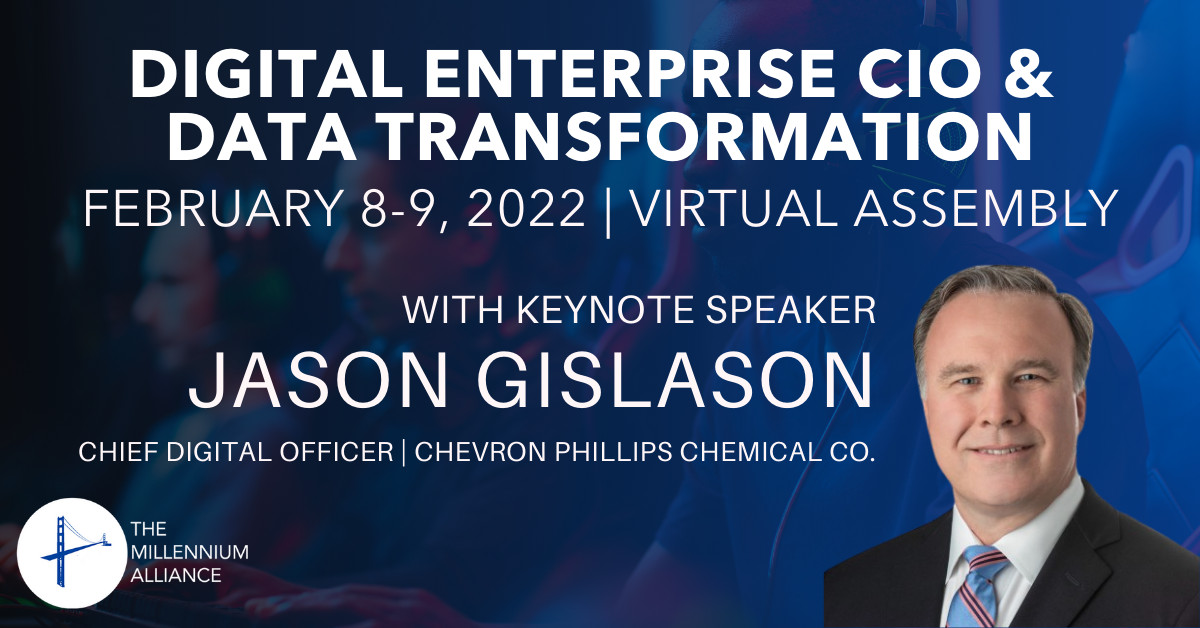
Next-Gen UX: Jason Gislason, CDO at Chevron Phillips Chemical shares insight on overcoming challenges to gain a competitive advantage. Jason starts his session by defining digital transformation – it demands revolutionary changes to key organizational components that will allow for the creation of new value streams. He adds that digitizing existing functions and processes is not enough to truly transform a company. He provides some tips on how to build a digital-ready culture to promote deep change in the organization:

  • Speed & agility: move fast and iterate, rather than waiting to have all the answers
  • Innovation: maximize impact through constant innovation
  • Collaboration: collaborate across functions to create synergy
  • Autonomy: allow your team high levels of discretion to do what needs to be done

He closes out the session with an important question to think about, “If your performance metrics remain the same before and after the so-called transformation, have you truly transformed?”

Digital Transformation: Widely Discussed but Poorly Understood: Derek Peterson, CTO at Boingo Wireless discusses the importance of optimizing and personalizing data to create value in a digital transformation. Connectivity is even more important today, as COVID-19 has accelerated digital strategies across all industries. He discusses the technology strategic vision follows the S.M.A.R.T model:

Secure Multi-platform Analytics-driven Responsive Tiered

It’s all about creating connective touch points for the consumer along their journey by using technology to build those experiences for the consumer.

Digital Enterprise & Data Keynote Fireside Chat

“2021’s New Normal: Adapting in the Face of Evolving Workforce Conditions”

Phil Fasano, CEO of Bay Advisors, and Monica Khurana, CTO at Dodge & Cox kick off a fireside chat on ransomware from a technology leader’s perspective. They shared their experiences and insights on ransomware, incident response plans, and zero trust.

Some key takeaways:

  • Implement table-top excercises and get comfortable with crisis management to prepare for a ransomware attack
  • Think about potential points of entry into your company, even on your personal devices
  • Practice, practice, practice – it enables you to work through the stress of an attack
  • Adopt the mentality that it’s not if you get attack, but when you will
  • Formulate an IT risk management committee, because accountability and transparency is critical to your shareholders 
  • Have all your controls and protections in place, and track your digital footprints
  • Network segmentation and building zero trust is important as we live in a very high connected ecosystem

Data Governance – Embedded, Invisible, and Agile! Santosh Kudva, CDO at GE Gas Power uncovers the importance of data governance. Data governance allows teams to efficiently and effectively deliver outcomes, and keeps your organization safe. Kudva adds that governance isn’t a bureaucracy, but it is invisible. Your framework has to be comprehensive and integrated to become a Business Innovation Enabler. The IT objectives in data governance are cybersecurity, access governance, data lifecycle management, change management, portfolio management, cloud ops governance, data loss prevention, financial management, design governance, and regulatory governance. Kudva closes his session with this bit of advice: the concept of data governance is a perfect balance between being invisible and agile.

Check out what is new with our Solution Providers

Espressive    |    MoveWorks    |     Sutherland    

Until Next Time…

Don’t miss out on the next Digital Enterprise CIO Transformation Assembly. Go here to request an invite for the November 17-18 Assembly!

Listen to #MillenniumLive on Amazon Music!

2021 has been a year of milestones for our #MillenniumLive podcast – we released on Spotify, recorded our 100th episode, and we were joined by some of the most influential guests to date. Now we’re thrilled to announce that #MillenniumLive is available for listening on Amazon Music! Haven’t listened to our podcast before? Here’s the low-down…

The #MillenniumLive podcast brings together thought leaders, academics, and innovators in the C-Suite that are digitally transforming various industries. Our areas of focus include Healthcare, Cybersecurity, Marketing, Retail, and Financial Services (DeFi, too!) We also have our Co-Founder Alex Sobol hosting a special series on Life & Leadership, where he discusses the road to success with industry elites. Interested in learning about the latest technology impacting your industry, or hearing about the strategies that C-Suite leaders are leveraging today? In the mood to listen to the real-life stories of leaderships amid COVID-19? Then #MillenniumLive is a must-listen for you!

Check out some of our most popular episodes:

  • Episode 130: Life & Leadership with John Felker, Former Assistant Director for Integrated Operations, Cybersecurity and Infrastructure Security Agency. Listen here!
  • Episode 129: Healthcare’s Future: Building Back Better with Jack O’Brien, Healthcare Analyst & Host of the HealthLeaders Finance Podcast. Listen here!
  • Episode 120: Craig Brommers & David Sable: Transformational Retail Strategies During COVID-19. Listen here!
  • Episode 114: Life & Leadership with Stephen Klasko, President, Thomas Jefferson University and CEO, Jefferson Health. Listen here!
  • Episode 108: Howard Krieger, CEO, unFederalReserve on Decentralized Finance. Listen here!

You can find #MillenniumLive on nearly every listening platform. Go here to subscribe! New episodes every week. 

#MillenniumLive Episode: Getting Started on your Data Journey with Joe DosSantos from Qlik

This week #MillenniumLive welcomes back Joe DosSantos, the Chief Data & Analytics Officer at Qlik. Joe gives some insight on offensive vs defensive data strategies, the importance of data accessibility, and provides tips on starting your analytics journey. He emphasizes the importance of understanding what your data is, tagging it, organizing it, and making it available to users with the help of automation. Joe notes that businesses need to think of data monetization and value creation in an offensive way as we see Amazon use it, whereas, in the healthcare and banking industries they typically take the more defensive approach. Joe continues with, it’s all about finding the right balance for data and using the data and analytics as a value driver for the company. Qlik’s executive insights center can aid in providing examples of use cases, how customers are using technology to solve problems and how to get started on your data journey.

powered by Sounder

Watch the video interview below, or listen on SpotifyAppleAmazon MusicGoogle Podcasts, or SoundCloud.

About Qlik

Qlik helps enterprises around the world move faster, work smarter, and lead the way forward with an end-to-end solution for getting value out of data. Our platform is the only one on the market that allows for open-ended, curiosity-driven exploration, giving everyone – at any skill level – the ability to make real discoveries that lead to real outcomes and transformative changes. And you get the freedom to use our cloud or any cloud you choose.

Want to learn more? Go here for more information!

Experiential Retail: A Post Pandemic Guide

Contributed by our partners at AnyRoad

Brick-and-mortar retailers saw significant reductions in foot traffic last year while e-commerce sales peaked in Q4 2020, but a natural balance is slowly returning as the pandemic subsides and competition among retailers is tougher than ever. As things open up, some brands (such as Home Depot, Williams Sonoma, etc.) that did well during COVID will be looking to maintain their sales volumes – while others that took hits will want to capitalize on reopening as a way to generate more sales.

But no matter how brands fared during COVID, one thing is now certain: retailers can no longer rely on opening new locations as a way to drive store traffic and sales. The pandemic challenged any retailer that “over-expanded” their physical footprint in previous years to right the ship and ensure their remaining stores were properly tailored to their target market.

Shrinking their footprints created opportunities to re-evaluate strategies around product mix, experiences, etc. – so now, post-pandemic, what is the value of a store visit?

Read the full report here

About AnyRoad

Welcome to the experience economy

AnyRoad is the data and insights platform powering leading brands to do smarter, better experiential marketing at scale. Founded in San Francisco in 2013 by Jonathan and Daniel Yaffe, AnyRoad is a leader in a new category of software called Experience Relationship Management (ERM). Over 200 brands including Anheuser-Busch, Honda, and the Golden State Warriors partner with AnyRoad to offer extraordinary experiences and draw insights from data to connect better with customers. AnyRoad is funded by Andreessen Horowitz, Rally Ventures, Precursor Ventures, and Marc Benioff. Go here for more information.

Transformational CISO Leader, Rinki Sethi, Keynotes Our November Assembly!

On November 8th, The Millennium Alliance Transformational CISO Assembly kicks off with a keynote address from Rinki Sethi, current Chief Information Security Officer (CISO) at Twitter. Rinki is an award-winning leader and executive with experience leading and developing innovative online security infrastructure for Fortune 500 companies like IBM, PG&E, Walmart.com, and eBay. She is recognized by CSO Magazine & Executive Women’s Forum with the “One to Watch” award, and in 2010, lead a team at eBay to receive the “Information Security Team of the Year” by SC Magazine.

In her keynote address, Rinki will discuss a variety of topics in cybersecurity including social media, her career shift into the security world, and more. Interested in learning from one of the most influential voices in technology? Go here to request an invitation to the virtual assembly!

About Rinki Sethi

Rinki Sethi is Vice President and Chief Information Security Officer (CISO) at Twitter responsible for leading efforts to protect its information and technology assets and advising the company’s continued product innovations in security. Previously Rinki was VP & CISO at Rubrik, Inc., and she has also held positions in online security infrastructure at Fortune 500 companies including IBM, Palo Alto Networks, Intuit, eBay, Walmart.com, and PG&E. Sethi also serves as an advisor to several startups, such as LevelOps and Authomize, and cybersecurity organizations, including Women in Cybersecurity.

Rinki has over 20 years of experience as a strategic leader and has received several awards, including the “One to Watch” from CSO Magazine and the Executive Women’s Forum, and the Senior Information Security Practitioner Award from ISC2. She also led an initiative to develop the first set of national cybersecurity badges and curriculum for the Girl Scouts of USA and contributed to the ISACA book, “Creating a Culture of Security.” Rinki holds several recognized security certifications and has a B.S. in Computer Science Engineering from UC Davis and an M.S. in Information Security from Capella University.

Sethi’s career began with PG&E as an information security specialist and became really passionate about cybersecurity when Walmart.com hired her two years later as a security engineer. She then spent the following 3 years at eBay as the Chief of Staff & Sr. Manager of Global Fraud, Risk & Security. Intuit hired her as an information security officer for two of their business units as they were going into the public cloud and moving data from TurboTax into AWS. Next, an opportunity to become VP of Information Security at Palo Alto Networks came up and she couldn’t resist the opportunity. After three years with Palo Alto Networks, Rinki left to take the role of VP of Information Security at IBM. After about four months with IBM, however, someone told Sethi about an opportunity at Rubrik and said she’d be a great fit as CISO. A year and a half later, it was mentioned to her that Twitter had been searching for a CISO and so she joined in September 2020 and is her current position as of now!

#MillenniumLive on Data-Driven Brand Experiences with AnyRoad

This week #MillenniumLive is tackling the topic of Experiential Marketing, and how brands are leveraging it to drive loyalty and lifetime value. We’re joined by Jonathan Yaffe, Co-Founder & CEO at AnyRoad, and he shares why we’re moving away from the “things” economy, and onto one more focused on experiences. He emphasizes the importance of data in the new world of experiential marketing, and understanding the relationship between experiences & consumers’ purchase behaviors. Yaffe’s team at AnyRoad allows marketers to accurately measure engagement, ROI, and pull actionable insights, and he shares some of the most impactful use cases of Experiential Marketing done right.

powered by Sounder

Watch the video interview below, or listen on SpotifyAppleAmazon MusicGoogle Podcasts, or SoundCloud.

About AnyRoad

AnyRoad was founded in San Francisco in 2013 by Jonathan and Daniel Yaffe, and they’re a leader in a new category of software called Experience Relationship Management (ERM). They boast over 200 brands including Anheuser-Busch, Honda, and the Golden State Warriors. Partner with AnyRoad to offer extraordinary experiences and draw insights from data to connect better with customers.

Want to request a demo? Go here for more information!

Shaping the Future: AI for Financial Services

Contributed by Pure Storage

The golden age of AI is here.

Financial institutions face new challenges and new digital-native competitors. AI and machine learning can be the key to generating more revenue, reducing costs, and enhancing customer experience while ensuring data protection and compliance. As a result, an unfettered, gold rush mentality has taken hold as organizations look for countless ways to deploy AI.

But while AI and ML have endless—and lucrative—applications in financial services, the AI opportunity doesn’t come without challenges. Ensuring that actual results match expected outcomes and that investments result in returns is vital. Here are just a few of the challenges you should be aware of as you establish an AI strategy.

  • Proof of Concept Purgatory One of the most common complaints regarding AI is the difficulty in moving from modeling to ROI. Time and resources are wasted, and the business is deprived of insights, when projects fail to see the light of day. Executives may also become frustrated and disillusioned, leading to valuable AI projects ending up in the scrap heap.
  • Supporting Data Scientists Without the proper infrastructure, data scientists spend time being data shepherds. Left unaddressed, valuable resources are underutilized and the business is deprived of higher-order insights.
  • Managing Resources The advent of the public cloud has been a boon to the development of AI opportunities and capabilities. But, if not used wisely, these same resources and tools can quickly lead to spiraling costs without the business outcomes to justify them.

Successfully leveraging AI’s capabilities requires you to address practical barriers and challenges. This means understanding not only your business challenges but identifying the optimal technology for each task and how to deploy it.

In our whitepaper, “Shaping the Future: Artificial Intelligence for Financial Services,” we examine key use cases that hold particular promise for AI in the financial sector and how to address the unique set of challenges.

About Pure Storage

Turn Bottlenecks into Breakthroughs

Rely on Pure’s Modern Data Experience™: innovative, cloud-ready solutions and the best experience in technology to transform data into powerful outcomes. Rely on Innovation Leadership: Pure has been a pioneer, from the all-flash data center to the most modern data-protection solutions and the Evergreen™ subscription model. Get Set, Get Cloud Ready: Pure offers everything-as-a-service for flexible consumption and cloud economics. Simple cloud mobility lets you seamlessly extend your data services into the cloud. Get the Best Experience: Pure delivers simple setup, effortless operations, and expansive integrations. But it’s the white-glove treatment of customers and partners that really sets Pure apart.

#MillenniumLive on 2021’s Tech-Driven Marketing Trends with Ameex Technologies

#MillenniumLive is joined by Prathap Venkatesan, Chief Growth Officer and Head of Digital Solutions & Digital Analytics at Ameex Technologies. We dive into how AI and other forms of digital transformation are impacting marketing, what Google’s recent algorithm changes mean for marketers, and 2021’s top digital marketing trends. Venkatesan also shares how Ameex Technologies brings together content, commerce, and technology to deliver a meaningful omnichannel experience.

powered by Sounder

Watch the video interview below, or listen on SpotifyAppleAmazon Music, Google Podcasts, or SoundCloud.

About Ameex Technologies

Ameex Technologies is a digital transformation and delivery partner helping clients ideate, design, build and deploy next generation, deeply integrated digital technology solutions. They bring together content, commerce, and technology to deliver an omnichannel experience for their clients. Their industry knowledge combined with their deep expertise in leveraging standardized processes, automation, data-driven analytics, and artificial intelligence/machine learning allows them to deliver a personalized experience across different platforms. Their flexible and cost-effective engagement models (project, FTE or outcome-driven) are bound to deliver high quality, highly scalable and on-time solutions that accelerate growth in the dynamically changing business environment.

Interested in learning more about their solutions? Go here!


David Sable on Why Wisdom-Sharing—Not Age—Makes a Leader

As originally published by David Sable on LinkedIn. Subscribe to the newsletter!

Many of my readers know that my late father was a Rabbi. Preacher’s kids issues aside, I grew up in an amazing community, founded in the mid ’50s and comprised of a multi-generational membership including Holocaust survivors, second (and more) generation Americans, young couples, families, singles, elderlies and a lot of kids running around.

For that reason, I had a plethora of mentors, young and old, to guide me. The most memorable of those were my father’s rabbinic mentors, many of whom were older survivors, and possessed a unique legacy to impart.

Given my upbringing, it comes as no surprise that I have always felt most comfortable in synagogues whose members were visibly and actively of mixed age groups. I love nothing more than being able to count my friend’s ages up 30 years and down 30 years from mine (although these days it’s mostly down).

When I joined Young & Rubicam in 1976, I was both surprised and happy to find a similarly broad spectrum of employee ages (though not a gender). The Madmen were still in place, but under them, a new wind was blowing. Computers were just being introduced for analytics, technology was transforming TV production, fax machines (round cylinders that spun around a page at a time) were starting to change the way we shared across offices—and training programs, like the one at Y&R, were few and far between and paid a pittance, but the training served the same purpose as grad school.

Experience was everywhere and everything. We had the opportunity to learn from the greats and from people who had themselves learned from the greats and from those who had learned from those who had themselves learned from the greats.

So, as I learned how to use a dial-up modem to access Y&R’s single computer a few floors down from my desk, I also learned how to write a memo, how to prepare and stage a presentation, how to develop a budget, how to staff a project, how to behave in a meeting (for example, we were not allowed to eat), how to take notes and always be ready to do so (still am), how to fold my cuffs up and under my sleeves to keep them clean and presentable, how to always send a note, quickly, after a meeting, thanking and confirming (still do) and on and on…

My teachers at Y&R belonged to every age group and some were only a year or two older than myself; however, all had specific professional expertise and had learned from each other. Alex, Sue, David, Mark, Barbara and Barbara, Michelle, Joe…and the list goes on, all having imparted lessons I still practice and pass on, and many are still friends, colleagues and mentors.

I was lucky that as I moved along in the business and shifted to other firms, I was able to find the same kind of mentorship. I sought out the experienced hands and sat myself down with them to soak it all in. Clients played a key role, too, as the industry icons I worked for on my side were equaled by those on the other. There were times when it felt like the Clash of the Titans, but I kept my head down and always listened.

And, I had the singularly blessed opportunity to work for and be mentored by two of the greatest legends in our industry: Harold Burson, founder of Burson-Marsteller, and Lester Wunderman, founder of Wunderman. Both now deceased, I miss them greatly, and during the 40+ years I knew them, I was in constant learning mode. Even after they (semi) retired, I continued our regular lunches and correspondence up until they passed, each well into their 90’s.

I write not to be nostalgic, but to be prescriptive. I am afraid that we are losing our connection to heritage across the board and in many industries. My great fear is that this loss will cost us as a society—in forgotten learning, wasted failures and missed opportunity.

It amazes me when I read or hear of a “never before” offering or capability—when I know it isn’t. I find myself attending more and more bizarre meetings, where no one has any historic perspective or notion that a topic being discussed has a rich history in which to delve. And, worse, it’s absurd when people can’t or don’t know how to make links between ideas and occurrences that might not be obviously related but share the same basic DNA or legacy.

All of this, I should point out, is occurring in an age when researching a subject has never been easier, and fear of AI replacing us is always simmering beneath the surface. It is my belief we humans maintain our edge over AI through this mentorship—the passing down of knowledge, wisdom and information, the sharing of experience through the lens of serendipity is what has always distinguished humankind from any other species…and we are in danger of giving it up.

So, while we opine on digital natives and generation this or that, I share with you that Harold and Lester—both close to 100 years old when they left us—knew more about the workings of digital communications, the use cases and potential use cases, the dangers and the opportunities, the potential, and the waste, more than anyone else, no matter their age. I also point out that some of my mentors were no older than me but had specialized experiences, making them invaluable sources of learning.

Ageism, hubris born of “what do you know,” ignorance, jealousy, fear of being shown up etc.…I have seen it all and it saddens me. Humankind has progressed by virtue of wisdom and experience. Once it was about what to chase and what to avoid; what to eat and what to pass on and what path to follow and which to never take. Today is no different.

It’s not always about being wiser, but rather of having more experience in failure and learning from those failures.

Sir Isaac Newton said it best…listen:

“If I have seen further, it is by standing upon the shoulders of giants”

 Revised to fit my own experience: “If I have had any success, it is because I was able to stand on the shoulders of giants—who let me, invited me and encouraged me.” And I might add, “my greatest success came by the generations that joined me and shared their experiences with me.”

Leadership is about learning. And it’s also about sharing. Learn and share. Don’t waste the opportunity for yourself or shortchange the next generation.